

Tribal Senior & Long-Term Care Evaluation
Final Report
This work was completed in August 2026. The final report detailing the process, results, and strategic recommendations for supporting SLTC for Tribal members in Montana is coming soon!
Background
The Long Term Services and Supports Strategic Planning - Strengthening Tribal Relationships: Listening Sessions and Needs Assessment is a contract from the Montana Department of Public Health and Human Services (DPHHS), Senior and Long Term Care (SLTC) Division. As part of a statewide effort to evaluate SLTC services across Montana, MORH/AHEC was tasked with ensuring that the needs and experiences of Tribal Governments and Urban Indian Organizations are represented in this evaluation. We hosted 23 listening sessions with Tribal communities and Urban Indian Organizations (UIOs) across Montana to understand the needs and identify opportunities for improvement when it comes to SLTC services. We worked closely with the MT Office of American Indian Health at DPHHS to collaborate with Tribes and UIOs through respectful consultation and engagement. This work was supported by the Money Follows the Person (MFP) demonstration program, which aims to build a sustainable system for community-based long-term care services.
Process & Timeline
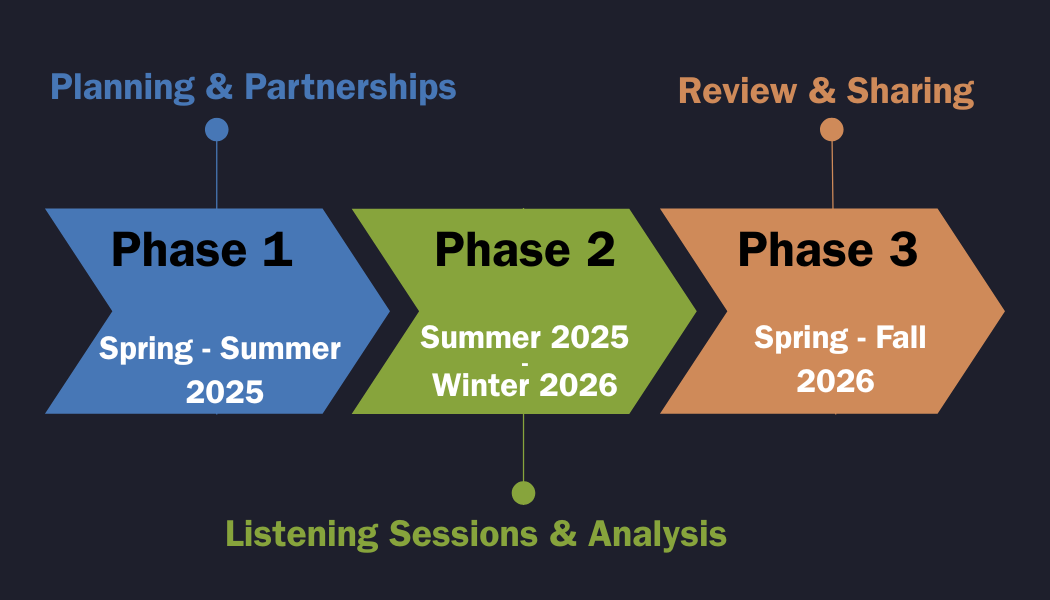
Phase 1: Planning & Partnerships
During phase 1, we focused on communication and partnership building with 8 Tribal Governments and 5 UIOs in Montana, including:
- Approaching each Tribal Government to share about the project and honoring the government-to-government relationship between the State of Montana and each Tribal Government.
- Obtaining input, ideas, and approval from Tribal Governments and UIOs to inform listening sessions at each site
- Applying for approval to conduct listening sessions as research activities from Tribal and other Institutional Review Boards
- Conducting a literature review of SLTC services for American Indian populations
Phase 2: Listening Sessions & Analysis
In phase 2, we hosted listening sessions with all communities that agreed to collaborate for this assessment. These listening sessions:
- Included up to 20 total participants at each site
- Asked about the needs, experiences, and opportunities for improvement related to SLTC services
- Heard from stakeholders in the SLTC services system. This may include Elders and older adults, family caregivers, healthcare/administrative staff, or Tribal/health leaders
- Analyzed the information shared to produce results and strategic recommendations
Phase 3: Review & Sharing
During phase 3, we reported what we learned from the listening sessions in each community. This involved:
- Sharing comprehensive community reports with findings from listening sessions with each community first for review
- Presenting community reports back to Tribal Governments, institutional review boards, and UIO leadership to obtain input and approval to share results in a final report to MT DPHHS
- Compiling and submitting a final report with strategic recommendations and approved results from each community to DPHHS
Contact
For any questions related to the Tribal Senior and Long-Term Care Evaluation, please contact Fiona Grubin at fiona.grubin@montana.edu or 406-994-6002.
The Montana Office of Rural Health and Area Health Education Center (MORH/AHEC) holds
our staff to high standards when working with Tribes in Montana. Tribal Nations are
sovereign governments with an inherent right to self-determination. Working in partnership
with Tribes requires understanding the history of the government-to-government relationship
Tribal Nations hold with the US government and approaching partnerships with respect
and appreciation for the diversity across Tribes.